
NEW ARCHITECTURE IN SPAIN: BEYOND THE HYPE
by theartwolf.com
A few weeks ago I read with surprise and happiness about the exhibition of Spanish contemporary architecture that the MOMA will held in the next months. But, in the last days, such happiness has been gradually turning into worry since I had the opportunity of reading the complete list of the works exhibited. Works that are certainly as bright and colourful as the most popular contemporary architecture is expected to be, but which raise many suspicious and unanswered questions that I will try to disclose.
Without any doubt, it is really difficult not to take interest in Spanish contemporary architecture. The economical, emotional and cultural boom caused by the end of Francisco Franco’s dictatorial regime, and the subsequent democratic changes, added to some punctual events such as the so called “Effect 92” (Olympic Games in Barcelona and the Universal Exhibition in Seville, both held in 1992) have turned Spain into a first class contemporary artistic atelier. The multicultural, even multinational character of Spain, added to the climatic and landscape variety, has created a broad spectrum of architectural answers, some of them certainly more brilliant than others.
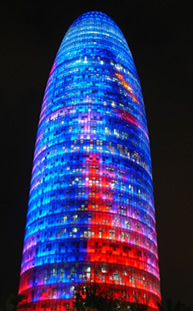
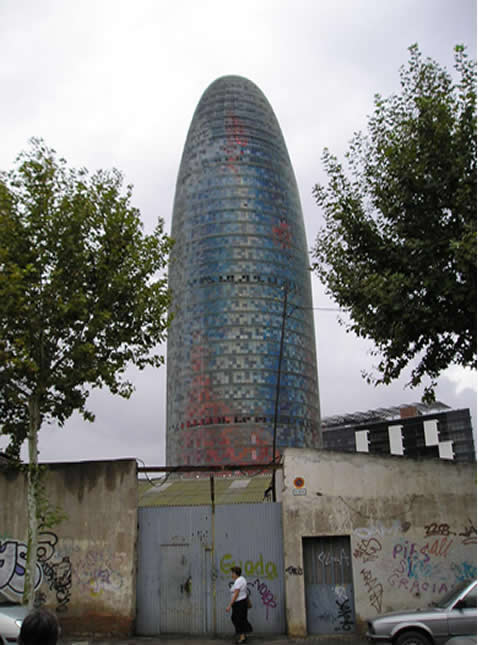
Jean Nouvel’s Agbar Tower. Barcelona’s new symbol… not for everyone
THE BARCELONA CASE
In this context, no other Spanish city proves to be more interesting or paradigmatical than Barcelona. After the economical and cultural boom resulted of the Olympic Games of 1992, the Catalonian capital turned into the arrowhead of the Spanish architectonical avant-garde, and, with the only possible exception of London and some interventions made in the German cities after the fall of the Berlin Wall, into the most interesting “collection” of contemporary architecture in Europe.
For example, have a look at one of the stars of the MOMA exhibition: Jean Nouvel’s Agbar Tower, a spectacular steel and glass kaleidoscope that formally resembles to… well, choose the comparison by yourself (yes, even a sexual one). It is true that the building has an undeniable beauty, but it is also even more true that some questionable aspects have accompanied it.
As in almost all the much-hyped architectonical works created in recent years, the publicity machinery that preceded its construction attended to proclaim the two greatest contributions that this colourful tower would bring to the city: the possibility of the birth of a new symbol to Barcelona, replacing Gaudí’s works such as the Sagrada Familia or “La Pedrera”; and a revitalizing boost to a quite depressed city district
Nevertheless, the result was quite questionable: in a city with the gothic splendour of its stunning Cathedral, the organized city planning by Ildefons Cerdá -possibly the most important urban city planning of the 19th century- and the organic, even mystic taste of Gaudí, it is really hard that such a phallic extravaganza achieve the category of symbol, at least in such a short time. On the other hand, a short visit to the kaleidoscopic Tower was enough to certificate my worst fears: such “revitalizing boost” is currently inexistent, and the building seems absorbed, selfish and self-indulgent, with no dialogue between it and its less fortunate neighbours.
Of course, the night view is fabulous, and the postcards sellers are surely very happy with this architectural trick by Jean Nouvel.
Another much-hyped architectonical intervention is the showground created for the “Forum de las culturas” (Forum of the Cultures) in 2004. Apart from polemical questions, both economical (even with the astronomical price of the tickets the event was an economic disgrace) and ecological (some groups criticise its impact on the Mediterranean surroundings) a simple analysis to the current situation of the Forum raise a very repetitive question: And now, what? What to do with an apparently useless showground, which includes a very beautiful building by Herzog & de Meuron? Two years after, this question is still unanswered, and the appearance of the showground is the living picture of desolation.
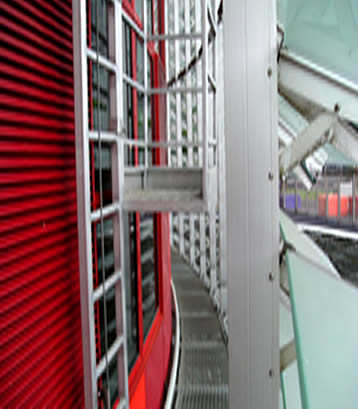
Complex metalwork at Agbar
Photo by theartwolf.com
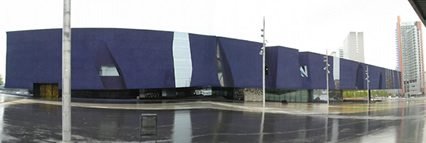
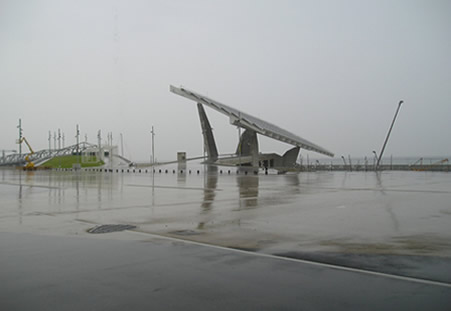
Desolation row… Forum of the Cultures
Photos by theartwolf.com
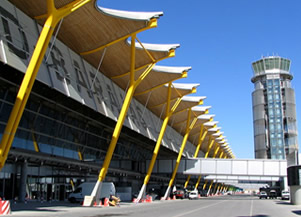
T4: Terminal of lost souls… or bags
THE CITY OF THE CULTURE
The monstrosity signed by Peter Eisenman that is currently being built in the suburbs of Santiago de Compostela is the result of the architecture competition organized by the Xunta de Galicia (Galicia’s Government) aimed to create a “cultural district” for the Galician people. Wow! Sounds nice, so… is there any objection to a project with such laudable aim? Well, yes, there is. Of course there is.
The first point criticized since the very first was the controversial location of the project, emplaced in a hill on the outskirts of Santiago, absolutely disconnected with the historic and cultural center of the city, establishing itself as a selfish and introverted “neocity”, completely apart of the medieval Santiago.
From a formal and constructive point of view, the project also presents reprehensible aspects. Of course, all opinions about forms and appearances are equally respectable and debatable, but the truth is that there is no coherence between the organic exterior image of the buildings and their internal space, very homogenized by the false roofs. Constructively, along with the disproportionate scale of many elements, there are a lot of controversial solutions, such as the library’s roof, finished with a 2 inches wide quartzite layer, increasing the weight of the 8000 square meters structure. We have also hear a rumour about Eisenman’s original and ridiculous idea of placing a useless column in the middle of the stage in the Opera House, an idea that could only be blocked when a group of architects convinced him not to do that, using the argument of that “sometimes you cannot see the forest for the trees”.
Another controversial point: the functionality of such a magnificent work. Does a city like Santiago de Compostela really need such “culture container”? Obviously not. Nevertheless, the dimensions are quite notorious: the Music Theatre exceeds 15000 square meters (3,7 acres) in area, as does the building called “New Technologies”. The Library is a gigantic (42 meters tall and 11000 square meters -2.7 acre- in area) walnut shell. Interestingly, Galician journalist and writer Ramon Chao wrote a few years ago that he had tried to donate his private library to the Culture Department of Galicia’s Government, and that he never received an answer. This weird issue can be used as an example of the also weird politics made during the Government of Manuel Fraga: first, we build a much hyped Museum, aimed to attract the attention of journalists and politicians. Then, let’s see what we can put into it.
The final point is without doubt the most polemical and shameful, and possibly not reflected at the MOMA’s exhibition: the endless and unstoppable rising of the project budget, initially estimated at €132 million (almost $150 million), but which has been unstoppably rising to €374 million ($450 million). But, in the very unlikely case that the project could be finished in its original shape and dimensions, many architects estimate that the final number could exceed an astonishing €500 million (almost $600 million). This number is enough to discredit Eisenman, his project and the crazy politicians that have defended such architectonical madness.
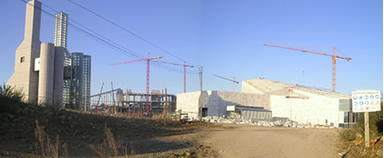
Eisenman’s infamous Ciudad de la Cultura, (image February 2006)
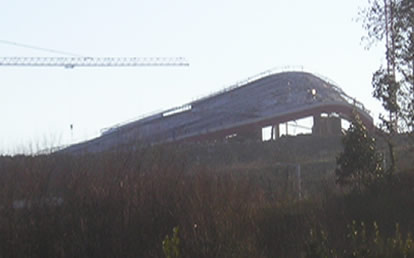
Natural hill, artificial hill : 374 millions… and rising
Photo by theartwolf.com
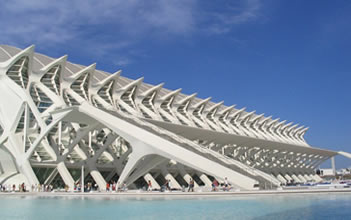
Calatrava: Science’s Museum, Valencia
POSITIVE ARCHITECTURE
Of course, not all Spanish architectural scene is so negative. In recent years, many young architects have created a new and sensible architectonical trend that has flourished in many interesting buildings.
For example, one of my biggest and nicest surprises while reading the first news about the MOMA’s exhibition was the inclusion of the Art Center of A Coruña, signed by Acebo y Alonso, arguably the most promising Spanish architects under 40 years old. The building, shown left, is, under its simple and even anodyne appearance, a brave experimentation aimed to combine in a same container two different functions (Conservatory and Provincial Museum). A glass skin covers the Conservatory and surrounds the concrete skeleton leading to the Museum.
Even some works initially criticised by many architects have brought more positive than negative results. Here we can talk about Santiago Calatrava and his best known work, The City of Arts and Sciences of Valencia. It is true that Calatrava’s personal interpretation of architecture -an often flamboyant mix of Engineering and Architecture- is not well accepted by many architects, but the final result was quite admired by neighbours and tourists; a building with a reasonable budget that -unlike Nouvel’s Agbar Tower- has revitalized a quite depressed zone
And that is all for now. As you can see, there are enough great architectonical projects to keep the faith on the Spanish architecture… Even though many users of the much hyped Barajas Airport Terminal 4 in Madrid (Richard Rogers and Antonio Lamela) are still looking for their bags.
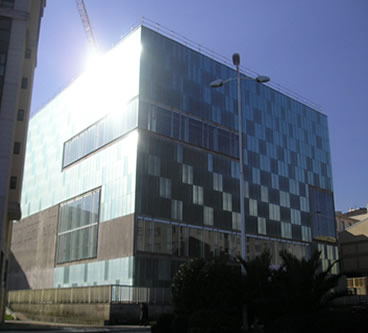
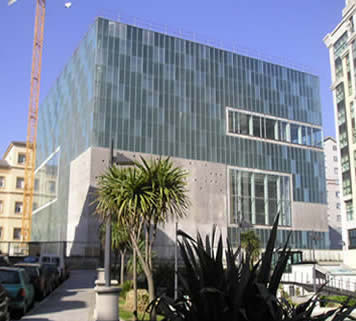
Acebo y Alonso: Museistic dichotomy
Photos by theartwolf.com
Follow us on:

